
Hiring a general contractor in Maryland requires more than comparing prices. The right professional understands local regulations, manages permits, coordinates subcontractors, and keeps projects moving from planning through final inspection.
Before starting construction or renovations in Maryland, Washington, D.C., or Northern Virginia, homeowners should understand licensing requirements, permits, timelines, and warning signs that help identify reliable contractors.
Licensing and Insurance Requirements
In Maryland, Washington, D.C., and Northern Virginia, general contractors must legally possess correct licenses and insurance. While the exact regulations might differ by location, confirming experience and proper coverage protects consumers by ensuring contractors are financially responsible and adhere to safety standards.

Maryland
General contractors in Maryland are licensed through the Maryland Home Improvement Commission (MHIC).
Contractor Licensing
Before applying for a license, applicants must take and pass a licensing exam. The following are the general requirements to obtain a license.
- Any home improvement-related misdemeanor or felony conviction must be reported to the Commission with a copy of the conviction records.
- Proof of a minimum of two years of home improvement or construction experience, or related education.
- Financial solvency
- Articles of incorporation for contractors representing corporations
- Trade name registered with the Department of Assessments and Taxation.
Insurance
- Proof of a minimum of $50,000 liability insurance
- Specialized trades, such as HVACR, require $300,000 for general liability and $100,000 for property damages
- Workers’ compensation is necessary for businesses with one or more employees
- Commercial auto coverage for vehicles used for business
Washington, D.C.
The District of Columbia Department of Licensing and Consumer Protection handles general contractor licensing.
Contractor Licensing
- Proof of a minimum of 4,000 hours or two years of experience
- Pass a DC-specific exam
- Obtain a business license with appropriate endorsements
- Maintain insurance
- Meet bonding requirements
- Submit a Clean Hands Certificate, ensuring no tax liabilities exceeding $100
Insurance
- Minimum liability insurance is $50,000 bodily injury or death for one person, $100,000 total for all claims, and $10,000 for property damage.
- Workers’ compensation for employees
- Commercial vehicle coverage
Northern Virginia
The Department of Professional and Occupational Regulation (DPOR) Board for Contractors licenses general contractors in Virginia.
Contractor Licensing
- Licensure requirements vary based on business registration as Class A, B, or C:
- Exam: All levels: Virginia General Portion for business/management and Virginia Content Portion for regulations
- Class A: Advanced Portion, in-depth regulatory, safety, and management compliance
- Trade Exams: Trade-specific
- Complete and pass a DPOR-approved eight-hour pre-license course
- License class requirements:
- Class A: Pass exams, no project limit, minimum $45,000 net worth, 5+ years of experience
- Class B: Pass exams, $129,000 per project, $750,000 annual limits, minimum net worth of $15,000, and 3+ years of experience
- Class C: Pass exams, $10,000 per project, $150,000 annual limit, and a minimum of two years of experience
Insurance
- Virginia doesn’t have a specified minimum liability requirement; however, contracts typically stipulate between $500,000 and $1,000,000 in coverage.
- Workers’ compensation: Three or more part-time or full-time employees, including subcontractor employees, must be covered.
- Commercial vehicle
- Builder’s risk for damage to the structure
- Surety bond: $10,000 required for licensing
Understanding Permits
Most major construction or remodeling projects require permits to ensure work meets local building codes. Generally governed by the International Code Council (ICC) standards, local permits are issued for project-specific work.
Projects That Typically Require Permits
Permits identify the specific type of work to be completed. For example:
- Interior: adding/removing walls, attic or basement renovations
- Exterior: roof replacement, siding replacement
- Structural: the demolition or addition of new structures like garages and sunrooms
- Systems: HVAC installation, plumbing, electrical
Who Handles Permits?
General contractors usually manage all necessary building permits and inspections. They serve as the main liaison with municipal building authorities. Contractors submit project plans, cover all associated fees, and arrange mandatory inspections as stipulated by the local jurisdiction.

Typical Construction Timelines
A construction timeline outlines the chronological phases of the project, from the initial concept through the final inspection.
Initial Consultation
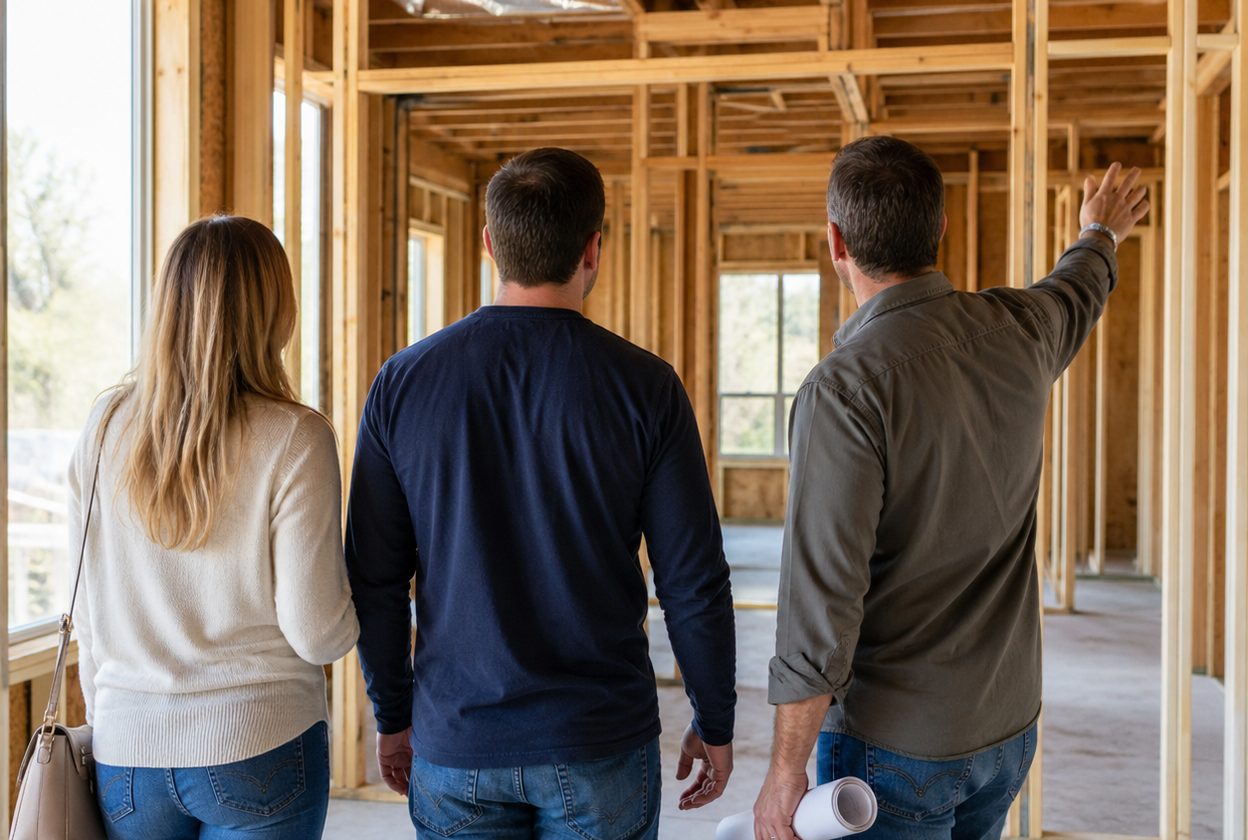
The initial consultation typically entails a 30- to 60-minute site walkthrough to discuss goals, timeline, and budget, and provide an overview of the process.
Planning and Permits
During the preconstruction phase, the contractor conducts a feasibility assessment, researching environmental factors and zoning regulations. Collaboration begins with architects, subcontractors, and inspectors. Permit applications are submitted, and budgetary requirements and timelines are fine-tuned.
Construction Phase
The actual building phase of the project involves managing day-to-day operations and ensuring on-time completion within budget. The general contractor coordinates subcontractors, orders and arranges material and equipment delivery, and safely completes key tasks, including site preparation, laying foundation, framing, and utility installation. Schedules must include key inspection points for foundation/footings and rough-ins. The final inspection occurs during the completion phase.
Final Completion
A final walkthrough involves any touch-up work, full cleanup, and final inspections by local authorities who sign off on the work before permits are closed out.
The GC provides the property owner with operating manuals, warranties, and spare parts before settling outstanding costs.
Estimates and Contracts
A detailed written estimate and contract clearly define the project’s scope, timeline, and budget. It protects both parties, prevents disputes, and builds trust.
What Should Be Included?
The estimate and contract should include:
- A detailed description of the project, including brands, materials, and the number of outlets
- Exclusions
- Itemized costs
- Timelines
- Permit and fee responsibilities
- Itemized costs
- Warranties and insurance
- Payment schedules
- Contractor and client information
Watch Out for Red Flags
Listen to your gut if you feel like something’s off with someone. Bear in mind a few common warning signs before hiring a general contractor.
Lack of Licensing or Insurance
Licensing and insurance are mandatory for contractors operating in Maryland, Washington, D.C., and Northern Virginia.
Large Upfront Payment Requests
Asking for more than 10-30% up front suggests operational problems.
Vague Estimates or Contracts
Vague estimates and contracts could leave you vulnerable to indefinite delays, surprise fees, or subpar materials. At the very least, it indicates poor planning.
Refusal to Pull Permits
A contractor who declines to obtain the necessary permits might be operating without a license or insurance, aiming to sidestep responsibility, or possibly seeking to reduce expenses and speed up the process.
Why Hiring a Local Contractor Matters
A licensed general contractor in Maryland understands regional building codes, permitting processes, and inspection requirements across Maryland, Washington, D.C., and Northern Virginia. This local experience can help projects move smoothly and avoid unnecessary delays.
Contact J&E Modern Construction for Quality General Contractor Services
Working with a reputable and experienced local contractor can save you time, money, and frustration. Begin the process by verifying the credentials of potential contractors. Carefully review estimates and contracts to ensure you understand the process, timeline, and costs.
Reach out to J&E Modern Construction to schedule a consultation with a knowledgeable member of our team. We offer a full complement of custom services, including bathroom, basement, and kitchen remodeling, deck building and repair, demolition and restoration, construction, and rental turnover.